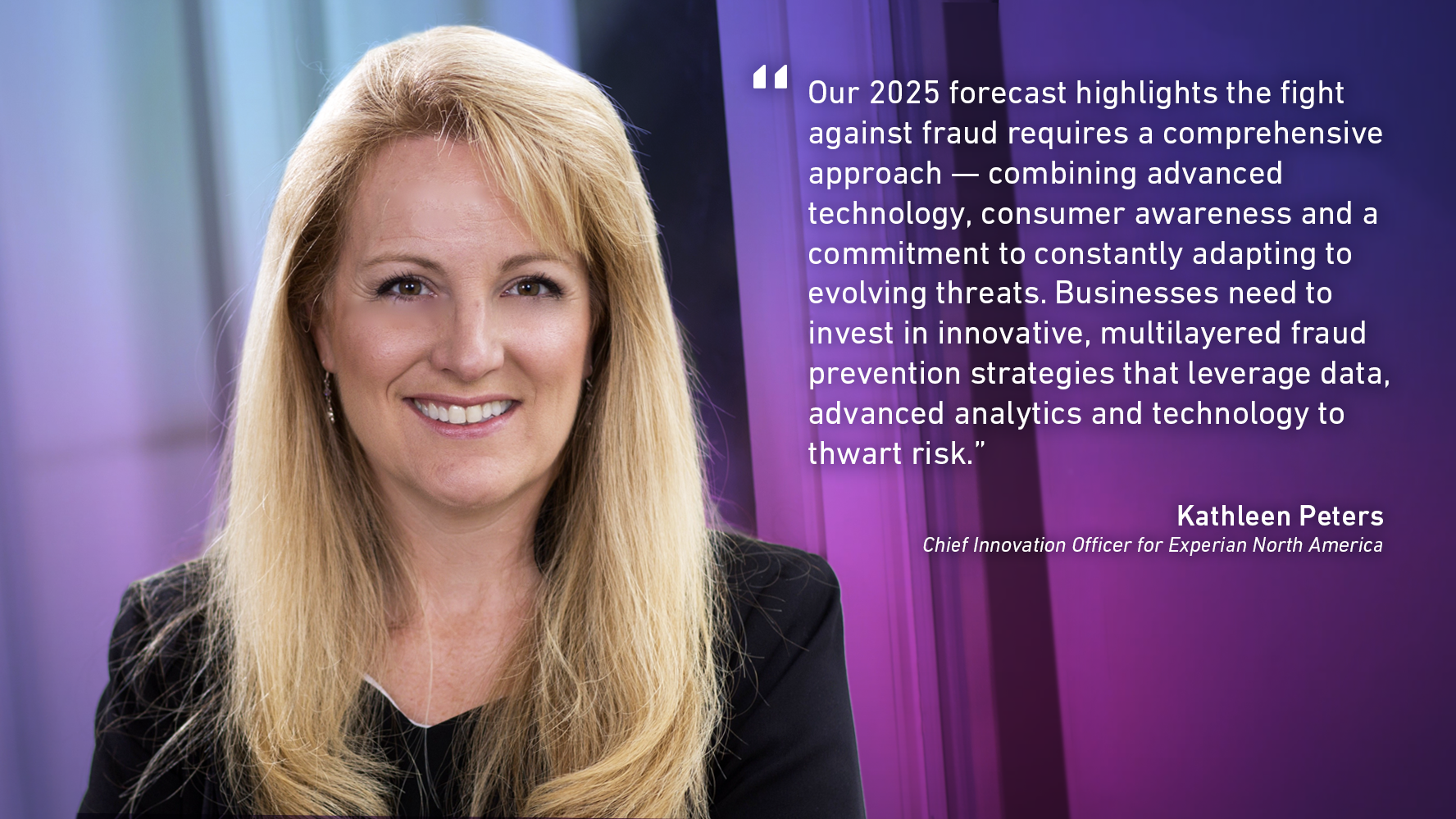
As we kick off a new calendar year, there’s already a lot of buzz in terms of expected advances in tech, especially for artificial intelligence. And what about fraud? Fraud isn’t just keeping pace with technology—it’s racing ahead. As the digital world expands, so too do the cunning schemes of fraudsters, who are more innovative and relentless than ever before. With businesses and consumers increasingly at risk, staying a step ahead requires insight into what’s next.
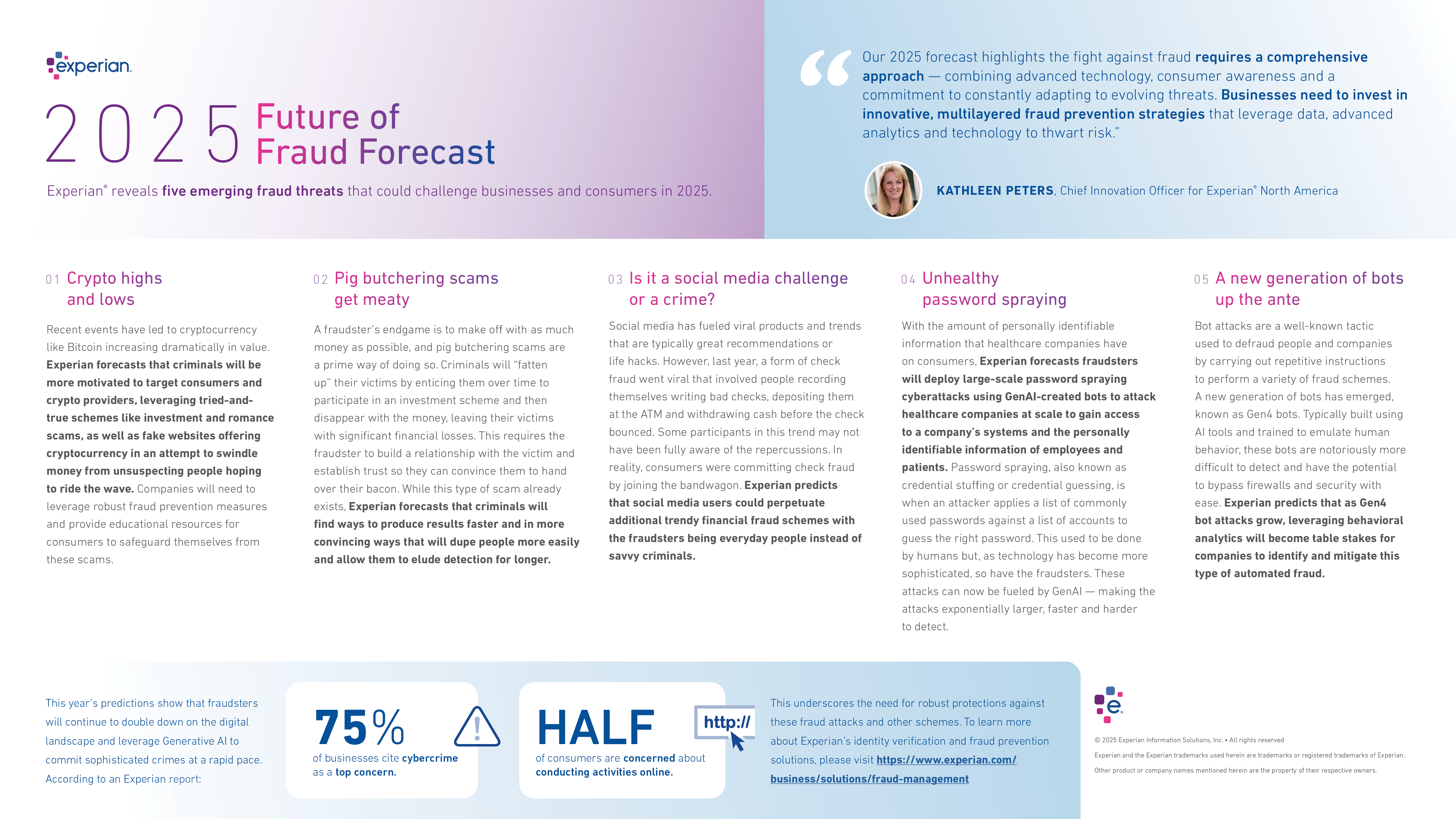
Today, we released our annual Future of Fraud Forecast to highlight five threats that could bring challenges this year for businesses and consumers. They include:
- Crypto highs and lows: Recent events have led to cryptocurrency like Bitcoin increasing dramatically in value. Experian forecasts that criminals will be more motivated to target consumers and crypto providers, leveraging tried-and-true schemes like investment and romance scams, as well as fake websites offering cryptocurrency in an attempt to swindle money from unsuspecting people hoping to ride the wave. Companies will need to leverage robust fraud prevention measures and provide educational resources for consumers to safeguard themselves from these scams.
- Pig butchering scams get meaty: A fraudster’s endgame is to make off with as much money as possible, and pig butchering scams are a prime way of doing so. Criminals will “fatten up” their victims by enticing them over time to participate in an investment scheme and then disappear with the money, leaving their victims with significant financial losses. This requires the fraudster to build a relationship with the victim and establish trust so they can convince them to hand over their bacon. While this type of scam already exists, Experian forecasts that criminals will find ways to produce results faster and in more convincing ways that will dupe people more easily and allow them to elude detection for longer.
- Is it a social media challenge or a crime? Social media has fueled viral products and trends that are typically great recommendations or life hacks. However, last year, a form of check fraud went viral that involved people recording themselves writing bad checks, depositing them at the ATM and withdrawing cash before the check bounced. Some participants in this trend may not have been fully aware of the repercussions. In reality, consumers were committing check fraud by joining the bandwagon. Experian predicts that social media users could perpetuate additional trendy financial fraud schemes with the fraudsters being everyday people instead of savvy criminals.
- Unhealthy password spraying: With the amount of personally identifiable information that healthcare companies have on consumers, Experian forecasts fraudsters will deploy large-scale password spraying cyberattacks using GenAI-created bots to attack healthcare companies at scale to gain access to a company’s systems and the personally identifiable information of employees and patients. Password spraying, also known as credential stuffing or credential guessing, is when an attacker applies a list of commonly used passwords against a list of accounts to guess the right password. This used to be done by humans but, as technology has become more sophisticated, so have the fraudsters. These attacks can now be fueled by GenAI — making the attacks exponentially larger, faster and harder to detect.
- A new generation of bots up the ante: Bot attacks are a well-known tactic used to defraud people and companies by carrying out repetitive instructions to perform a variety of fraud schemes. A new generation of bots has emerged, known as Gen4 bots. Typically built using AI tools and trained to emulate human behavior, these bots are notoriously more difficult to detect and have the potential to bypass firewalls and security with ease. Experian predicts that as Gen4 bot attacks grow, leveraging behavioral analytics will become table stakes for companies to identify and mitigate this type of automated fraud.
Being proactive is paramount in the fight against these and other future fraud threats. Businesses should work with a trusted partner to ensure that they leverage the right data, advanced analytics and technology to mitigate risk. Experian offers identity verification and fraud prevention solutions available on the Experian Ascend Platform™ to help companies anticipate, prepare for and fight fraud. Learn more about Experian’s fraud prevention offerings here.

As we approach 2026, artificial intelligence is no longer just a tool for innovation—it’s a weapon in the hands of cybercriminals. Our 13th Annual Data Breach Industry Forecast, released today, highlights how AI is poised to redefine the cybersecurity landscape, introducing a new era of highly personalized, persistent, and technologically advanced attacks. We outline six key predictions, with AI emerging as the central theme. From synthetic identities and autonomous AI agents to shape-shifting malware and even vulnerabilities in brain-computer interfaces, the forecast paints a picture of a threat environment that’s evolving faster than many organizations can keep up with. The stakes are high. In the first half of 2025 alone, more than 8,000 global data breaches exposed approximately 345 million records [1]. Experian’s clients in the United States, United Kingdom, and Canada were among the hardest hit. Consumers Are Feeling the Impact To check the pulse of how consumers are feeling about the impact of AI on security, we recently conducted a national survey in the U.S. and UK. The findings reveal growing anxiety around AI-driven threats. In both the U.S. and U.K., more than 80% of respondents expressed concern about AI being used to create fake identities indistinguishable from real people. Millennials appear especially vulnerable, with 1 in 4 reporting identity theft in the past year and nearly a quarter falling victim to phishing attacks. The findings also show a lack of confidence in corporate defenses: 69% of U.S. adults don’t believe their bank or retailer is prepared for AI-driven attacks. 76% believe cybercrime will continue to escalate and become impossible to slow down due to AI. 35% worry about being held personally liable for cybersecurity mistakes at work. Preparing for the AI-Driven Future While the threats are daunting, organizations can turn the tide by adopting AI defensively. Proactive investments in AI-powered threat detection, employee training, and incident response planning will be critical in 2026 and beyond. Experian Data Breach Resolution has more than 20 years of experience helping companies manage a security incident and it’s no different today than it was two decades ago – the same technologies that are being used against us can also be used to protect us. AI can help detect anomalies faster, automate responses, and reduce human error. But it requires investment, training, and preparation. To review all six predictions, download the paper here. Understanding what’s coming is the first step toward building a stronger, more resilient cybersecurity strategy. [1] Data Breach Statistics 2025: Key Trends, Costs & Risks Revealed, SQ Magazine, October 6, 2025

We’re excited to share that Experian has been honored with Datos Insights’ 2025 Impact Award for Best First-Party Fraud Innovation, earning Silver Medalist recognition for our First-Party Fraud Scores. This award isn’t just about technology, it’s about protecting people, businesses, and the trust that connects them. Rethinking How We Detect Fraud Fraud today doesn’t always look like the stereotypes we imagine. Sometimes it comes from individuals who apply for credit with no intention of paying it back. That’s where Experian’s First-Party Fraud Scores make a difference. Unlike traditional credit tools that mostly look at repayment history, our models dig deeper into intent. By combining credit and non-credit data with advanced machine learning, lenders can spot risks in real time, stopping fraudulent applications before they turn into financial losses. As Jim Mortensen of Datos Insights explains, “By analyzing patterns across multiple institutions and industries, the solution can identify fraud schemes that would otherwise go undetected.” That broader visibility is key to staying ahead of fast-evolving threats. Why This Matters At Experian, innovation is never just about technology. It’s about trust. It’s about helping people, keeping businesses strong, and protecting the integrity of the financial system we all rely on. We’re honored by this recognition from Datos Insights, but even more motivated to keep raising the bar in fraud prevention for our clients, for consumers, and for the future of financial confidence.

At Experian, innovation and preventing fraud go hand in hand. That’s why we’re excited to announce a new partnership with Incode Technologies, a global leader in AI-driven identity verification. Through this collaboration, Incode’s advanced technology is now integrated into the Experian Ascend Platform™, helping organizations across industries make faster, smarter, and more secure decisions. With this integration, more than 1,800 global clients—from financial services and healthcare to automotive and digital marketing—can benefit from seamless, real-time identity validation. Incode’s AI-powered solutions verify and connect identity elements such as government-issued IDs, facial recognition, liveness checks, and metadata analysis. The result is stronger protection against synthetic identity fraud and application fraud, while maintaining a frictionless customer experience. In North America, Incode’s solutions will be offered within Experian’s CrossCore Document Verification suite, with global expansion already planned. This flexibility allows businesses to tailor their fraud and risk strategies with unmatched agility and precision. By combining Experian’s global software expertise with Incode’s AI-powered identity verification, this partnership strengthens our mission to help businesses and consumers build trust in an increasingly digital world.